
Blog

/Blog/

Doing Change God’s Way (Part 8)

The Sin That Entangles

Introduction

  • Resolutions Require Change, but it is Hard to Change
  • Doing Change God’s Way
  • Last week we discussed habits and change; today we will begin to make specific applications to some difficult sins.

I.  Review: Principles for Change

  • Know that God Demands, Grants, and Welcomes Change.
  • Achieve Balance as Fully Integrated Beings.
  • Focus on System or Process Instead of Goals Alone.
  • Set Priorities. Choose between the Urgent, Important, and Unimportant.
  • Understand the Limits of Willpower.
  • Engineer New Habits; Modify Old Ones (Romans 12:1-2).

II.  Application: Eliminating the Sin that Entangles Us

Conclusion

  • Lessons to Take Home
    • You Can Change Your Life.
    • You Can Overcome Bad Habits & Sins.
    • It takes Planning and Work.
    • It takes Dependence on God.
  • Are You Doing Change God’s Way?

Creating new habits and modifying old ones are the best uses of will-power to bring about lasting change in our lives.  Romans 12:2 is a model for this approach, Do not conform any longer to the pattern of this world, but be transformed by the renewing of your mind. The key is the “renewing of your mind” which, in this series, I have defined as “repentance.” This renewing also involves being mindful of the cues, routines, and rewards associated with our behavior and being present in the moment to consistently modify one or more of these to produce a new behavior.

How does this work in real life?  Sunday’s lesson is an application of these principles to some of the areas in our lives we might want to change.  It is entitled, The Sin that Entangles.

Hebrews 12:1  Therefore, since we are surrounded by such a great cloud of witnesses, let us throw off everything that hinders and the sin that so easily entangles, and let us run with perseverance the race marked out for us.

I hope you will join us!  Joey
By | 2022-02-19T19:53:30-07:00 February 19th, 2022|Uncategorized|0 Comments

Doing Change God’s Way (Part 7)

Habits And Change

Introduction

  • Resolutions Require Change, but it is Hard to Change.
  • Doing Change God’s Way
  • Last week we discussed willpower and change; today we will discuss habits and change.

I.   God Made us Habitual Beings.

II.  Godly Living Requires Breaking Bad Habits and Engineering Good Habits.

III.  Biblical Examples of Habitual Behavior

  1. Prayer is a Habit (1 Thessalonians 5:16-18).
  2. Good Thoughts are Habits (Philippians 4:8).
  3. Church Attendance is a Habit (Hebrews 10:24-25).

IV.  Behaviorally, Habits Consist of Three Parts: A Cue, a Routine, and a Reward (Craving).

V.   Establishing Good Habits Eliminates the Necessity of Willpower.

VI.  Bad Habits Cannot be Eliminated, but they Can be Modified.

VII. It Takes 21 Days for a Habit to Take.

Conclusion

  • Applications
    • The Holy Spirit Does the Transforming of Our Character.
    • Decide Ahead of Time How to Act.
    • Limit Your Alternatives.
    • Build Good Habits to Eliminate the Need for Willpower.
    • Willpower is Best Used When Building or Modifying Habits.
    • Start with “Micro-Habits” & Increase Later.
  • Are You Doing Change God’s Way?

Last week we discussed willpower.  Self-control is vital to Christian living and for making any change in our lives.  However, we all have a love/hate relationship with self-discipline.  Studies have shown that willpower is like a muscle; the more we use it, the stronger we get, but, like a muscle, it also fatigues and will fail.  The secret to using willpower is to employ it in the creation and modification of habits.

God has created us so that we can automate routine tasks. Our brain creates automatic behaviors that consist of three parts: a cue, a routine, and a reward.  When repeated over time they form habits. The way to use willpower to create or modify habits is to be intentionally mindful at one or more of these three stages and modify the cue, routine, and/or reward. Over time, with repetition, new habits are formed and old ones modified.

If we have the bad habit of angry outbursts.  We understand the cue to be something that “sets us off.” By being mindful in that moment, we can intentionally modify our response.  However, we must also modify the reward, by redirecting our catharsis in another direction.  Over time we can transform this habit into something more positive.  More on Sunday!

I hope you will join us!  Joey

By | 2022-02-12T20:16:47-07:00 February 12th, 2022|Uncategorized|0 Comments

Doing Change God’s Way (Part 6)

Willpower And Change

Introduction

  • Resolutions Require Change, but it is Hard to Change.
  • Doing Change God’s Way
  • Last week we discussed prioritizing change; today we will discuss the relationship of willpower and change.

I.   Willpower is Described as Self-Control or Self-Discipline in the Bible.

II.  Willpower/Self-Control is Necessary for Godly Living (Acts 24:25).

III. Willpower/Self-Control is Vital for Avoiding Sin (1 Corinthians 7:5; 2 Timothy 3:1-3).

IV.  Willpower/Self-Control is an Essential Christian Virtue (2 Peter 1:6).

V.    Willpower/Self-Control is Fruit Produced by the Spirit (Galatians 5:22-25).

VI.  Willpower/Self-Control Can be Taught and Learned (Titus 2:2, Titus 2:3-6, Titus 2:11-13).

VII. Willpower/Self-Control Can Grow Stronger with Use (1 Corinthians 9:24-27).

Conclusion

  • Applications
    • Willpower is Required for Change.
    • You can Increase Your Willpower.
    • Willpower Alone is NOT Sufficient.
    • We are Weak and often Fail.
    • The Holy Spirit will Help us Strengthen our Willpower.
    • We Must Cooperate with the Spirit.
    • There is a Secret to the Use of Willpower.
  • Are You Doing Change God’s Way?

Obviously, willpower and self-control are vital for accomplishing any kind of change in our lives.  This is true in both spiritual and physical dimensions of our lives (though we have seen there is a connection between the two). Doing Change God’s Way requires self-discipline.

Self control is necessary for godly living and avoiding sin.  It is an essential Christian virtue that is produced by the Holy Spirit with our cooperation.  It is something that can be taught and learned and it can grow stronger with use.  However, there is a secret about willpower that is vital to understand.  Willpower can only take us so far along the path to change; after that, our resolve begins to wane.  However, if applied in a specific way, it can be extremely effective.  What is that secret?  I’ll say more in the lesson.

I hope you will join us!  Joey


By | 2022-02-05T12:45:27-07:00 February 5th, 2022|Uncategorized|0 Comments

Doing Change God’s Way (Part 5)

Prioritizing Change

Introduction

  • Resolutions Require Change, but it is Hard to Change.
  • Series Title: Doing Change God’s Way
  • Last week we discussed process driven change; today we will discuss prioritizing change.

I. We Must Set Priorities to Please God.

II. We Must Set Priorities to Be Successful.
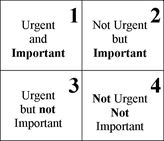
III. We Must Choose Between the Urgent and the Important.
Four Types of Tasks:

  • Those Tasks which are Urgent and Important
    • Do these First.
  • Those Tasks which are Not Urgent, but Important
    • Spend Your Time Here.
  • Those Tasks which are Urgent, but Not Important
    • Minimize These.
  • Those Tasks which are Not Urgent and Not Important.
    • Eliminate These.

Conclusion

  • What Should Go in Quadrant 2 (Not Urgent, but Important):
    • Your Relationship with God
    • Your Physical Health
    • Your Marriage / Family
    • Your Church Responsibilities
    • Your Work Responsibilities
    • Your Other Relationships
    • Your Dreams, Goals, Self-Improvement
  • Are You Doing Change God’s Way? (Acts 22:16; 1 John 1:9)

As we seek to make changes in our life – spiritual and physical, it is important to put “first things first!”  God demands we put him first in our allegiances, time, and goals. Further, we all understand that success in any endeavor requires we set priorities. Among other things, this means we must learn to choose between the urgent and important.


I’ve reproduced this chart from my message this coming Sunday. Our activities can be categorized in each of these four quadrants.
Q4 are things we need to minimize or eliminate.
Q3 are things which should be minimized.
Q1 are things we need to do first.
Q2 is where we need to spend most of our time.
Q2 includes things such as our

  • 1) relationship with God;
  • 2) physical health;
  • 3) marriage / family;
  • 4) church responsibilities;
  • 5) work responsibilities;
  • 6) other relationships;
  • 7) dreams, goals, self-improvement.

I’ll say more in the lesson.

I hope you will join us!  Joey

By | 2022-01-26T00:13:27-07:00 January 26th, 2022|Uncategorized|0 Comments

Doing Change God’s Way (Part 4)

Process Driven Change

Introduction

  • Resolutions Require Change, but it is Hard to Change
  • Doing Change God’s Way
  • Last week we discussed holistic change; today we will discuss process driven change.

I.  Goal Emphasis vs. System Emphasis (Process)

  • Coach: Goal=Championship; Process=Daily Practice.
  • Writer: Goal=Book; Process=Daily Writing Schedule.
  • Runner: Goal=Marathon; Process=Training Schedule.
  • Entrepreneur: Goal=Million Dollar Business; Process=Sales and Marketing Process

            Focus on the How, not the What.

II.  A Proven Formula for Success

III.  A Biblical Model

Conclusion

  • Six Reasons to Focus on Systems not Goals:
    • Goals Can Lead to Discouragement.
    • Goals Can Impede Long Term Progress.
    • Goals Imply there are Things we Can Control that we have No Control Over.
    • Systems are Working Plans for your Goals.
    • Systems, if Appropriately Designed, will Lead to Goal Achievement.
    • What you do Every Day (Your System/Process) Will Change Your Life.
  • Are You Doing Change God’s Way?

Since I’m originally from Alabama, it is probably no secret that I am a University of Alabama college football fan. I know there is a lot of hate for the program because of their unprecedented success over the last twelve years, but no one can argue with their success or the greatness of their coach. Nick Saban turned the program around, at least in part, due to what he has called “The Process.” He tells his players and assistant coaches, “Don’t think about winning the SEC Championship. Don’t think about the national championship. Think about what you needed to do in this drill, on this play, in this moment. That’s the process: Let’s think about what we can do today, the task at hand.”  This is also a biblical concept.

Our current lesson series, Doing Change God’s Way, is intended to help us make necessary changes in our lives. Change is difficult, but God has provided in his word a path to real change. Sunday, my lesson will discuss Process Driven Change.    I’ll say more on Sunday.

I hope you will join us!  Joey

By | 2022-01-22T13:01:18-07:00 January 22nd, 2022|Uncategorized|0 Comments

Doing Change God’s Way (Part 3)

Holistic Change

Introduction

  • Resolutions Require Change, but it is Hard to Change.
  • Doing Change God’s Way
  • Last week we discussed the four stages of repentance; today we will discuss holistic change.

I.  We are More than “Ghosts in a Shell.”

  • Plato thought of the Soul as Imprisoned in the Body.
  • Descartes thought the Soul was what Distinguishes Humans.
  • Negative Implications of Body/Soul Dualism:
    • Confusion of Soul/Body with Good/Evil.
    • Confusion of Life after Death with Life after Life after Death.
    • Confusion of the True Nature of Salvation.
    • De-emphasis of the Body.
    • De-emphasis of the Resurrected Body.
    • De-emphasis of Christian Virtue.
    • De-emphasis of Christian Mission.

II.  We are Fully Integrated Beings.

  • Soul, Spirit, Body, Heart, etc. Integrated into a Holistic Being.
  • We Cannot Separate a Specific Part that is “Me.”

III.  We Need to See Change as a Holistic Process.

  • Jesus as our Guide…
  • Jesus grew    Intellectually    Physically     Spiritually     Socially
  • Love God with all Your    Heart    Soul     Mind     Strength

Conclusion

  • Applications
  • Change is not Simple.
  • Change Involves the Whole Person in Every Dimension.
  • Include Multiple Aspects of Yourself in Every Change.
  • Are You Doing Change God’s Way?

The current lesson series is intended to help us make necessary changes in our lives. I have planned these messages to coincide with our New Year’s resolutions.  You may have given up on resolutions, but that’s my point.  Change is difficult, but God has provided in his word a path to real change and the Scripture is full of practical principles.  The series is entitled, Doing Change God’s Way.

Sunday, my lesson will involve how we can pursue Holistic Change. We have been incorrectly taught a soul/body dualism that confuses the nature of our existence. We often see issues as either physical or spiritual and approach their resolution in the same way.  However, we are holistic beings – body, mind, soul, spirit, etc. and each aspect of our being affects the whole.  There are spiritual aspects of physical change and physical aspects of spiritual change.  I’ll say more on Sunday.

I hope you will join us!  Joey

By | 2022-01-14T00:04:46-07:00 January 14th, 2022|Uncategorized|0 Comments

Doing Change God’s Way (Part 2)

What Is Repentance?

Introduction

  • Resolutions Require Change, but it is Hard to Change
  • Doing Change God’s Way
  • Last week we saw that God Demands, Grants, and Welcomes Repentance. This week: What is Repentance?

What is Repentance? Five Words:

What is Repentance? Three Elements:

  • An Intellectual Element: A Change of Mind
  • An Emotional Element: Regret/Remorse
  • A Volitional Element: A Change of Will/Life

What is Repentance? Four Stages

  • A True Sense of Your own Guilt and Sinfulness before God
  • An Understanding of God’s Mercy in Chris
  • A Hatred of Sin and Turning from it to God
  • A Persistent Endeavor to Live a Holy Life of Obedience

Conclusion

  • Applications
    • Have you Turned to God in Genuine Repentance?
    • Are there Lingering Sins from which you Need to Repent?
    • Feeling Bad is NOT Enough.
    • External Change is NOT Enough.
    • True Repentance is Inside Out.
  • Are You Doing Change God’s Way?

Repentance is more than feeling bad about what you have done.  Sure, remorse is involved, but repentance goes beyond regret.  The NT word used most often to describe it means to “change your mind.” When we truly repent, we change the way the think about sin.  We change the way we want to live. Instead of serving ourselves, we choose to serve God.

The Scripture also makes it clear that true repentance (changing our mind) results in a changed life.  John the Baptist spoke of producing “fruit in keeping with repentance” (Matthew 3:8).  The Thessalonians turned to God from idols to serve the living and true God” (1 Th 1:9).

Change, God’s way, is revolutionary.  Perhaps that’s why we struggle with our resolutions; we haven’t tried doing change God’s way.  This is the theme of my lesson series this Jan/Feb.  I hope you will join us!

Have a Happy New Year!  Joey

By | 2022-01-07T11:51:38-07:00 January 7th, 2022|Uncategorized|0 Comments

Doing Change God’s Way (Part 1)

Repent or Perish

Introduction

  • Resolutions Require Change
  • It’s hard to Change
  • Doing Change God’s Way

I.    God Demands Repentance

II.   God Grants Repentance

III. God Welcomes Repentance

  1. He Wants All Saved (2 Peter 3:9)
  2. He Rejoices (Luke 15:7)
  3. He Dwells with the Contrite (Isaiah 57:15)

IV.  Conclusion

  • Applications
    • You Cannot Stay Where You are and Go with God.
    • All of our Brokenness Originates in our Sinfulness.
    • God has Provided a Means for you to Change
    • God Welcomes You When You Repent.
  • Are You Doing Change God’s Way

How are you at keeping New Year’s Resolutions?  If you’re like me, you probably never get past the end of January with most of them.  Some of us have given up on resolutions altogether figuring that they are wasted effort inviting failure.

However, such thinking can be unproductive. Change is a necessary part of life and should be a serious part of our regular evaluations of life.  In a spiritual context, Jesus commands, “Repent… or perish” (Luke 13:3).  That can also be true in other areas of life.

The Bible says a lot of about repentance (change).  Perhaps, we haven’t tried doing change God’s way.  This will be the theme of my lesson series beginning January 2, 2022.  I hope you will join us!

Have a Happy New Year!  Joey

By | 2021-12-31T17:10:26-07:00 December 31st, 2021|Uncategorized|0 Comments

God Always Has A Remnant

A remnant is defined as a small surviving group of people.  It is sometimes defined as something left over. At other times it is defined as a leftover piece of fabric remaining after the rest has been used up or sold.

During the days of the Prophet Isaiah, God gave Isaiah a vision of Israel. The vision was told by Isaiah in Isaiah 1:1-9. Isaiah said the nation had become “a sinful nation, a people laden with iniquity, a seed of evildoers, children that are corrupters: they have forsaken the Lord, they have provoked the Holy One of Israel unto anger, they are gone away backward.’ Isaiah went onto say in  verse 9, “Except the Lord of hosts had left unto us a SMALL REMNANT, we should have been as Sodom, and we should have been like unto Gomorrah.”

In the book of Malachi the final book of the Old Testament we read in Chapter 3

16 Then those who feared the LORD spoke to one another, and the LORD gave attention and heard it, and a book of remembrance was written before Him for those who fear the LORD and who  esteem His name. 17 “They will be Mine,” says the LORD of hosts, “on the day that I prepare My own possession, and I will spare them as a man spares his own son who serves him.” 18 So you will  again distinguish between the righteous and the wicked, between one who serves God and one who does not serve Him.

The New Testament tells us in Romans 11:5, “Even so then, at this present time, there is a remnant according to the election of grace.”

Never throughout the long history of Israel and what we find recorded in The Bible did 100 percent of the nation worship God, there was always a faithful Remnant …

Remnant in The Bible is always a two-sided word. In the first instance it speaks of disaster and loss ahead.

But there is promise found in it too. It will not be a total catastrophe, for there will be a divinely preserved remnant.” Gods People are His Remnant!

The remnant is preserved by God himself God always has a Remnant that have not bowed the knee to Baal. Who are Circumcised at The Heart.

God’s remnant are those who stand on God’s word and not the word of man, politicians, the media and hirelings.  They believe God’s Word is true today, yesterday and forever. Political  correctness is not part of the character.

God still has a remnant today. Are you part of God’s Remnant?

Michael Kamplain

By | 2021-12-25T21:42:44-07:00 December 25th, 2021|Uncategorized|0 Comments

Joy To The World!

The Gospel of Luke gives the most detailed story of the birth of Christ and also the most detailed prescription for joy. Luke wants us to see that the story of the world meeting Jesus in the flesh is a story of the world finally finding full joy in God.

It begins with the birth of John the Baptist. The angel said to Zechariah:

Your wife Elizabeth will bear you a son, and you shall call his name John. And you will have joy and gladness, and many will rejoice at his birth, for he will be great before the Lord. . . and he will go before him to make ready for the Lord a people prepared for him. (Luke 1:13–17)

What is the significance of God coming to us and being with us? In this very act we see God’s powerful and engaging love. God was not content to love us from a distance. He desires to be with us … to be involved in the details of our lives. We also see Jesus’ birth as an act of God initiating this loving relationship.

And this loving relationship is for everyone – let earth receive – it’s for the poor, rich, young, old, all genders, all ethnicities, all the earth! God wants to be with you, wherever you are.

I like what this writer said about how many of us feel around the holidays:

Rejoice in the Lord always; and again I will say, Rejoice!  Philippians 4:4

There’s a couple of ways to respond when you encounter joy.

One way is to act like so many of the antagonists we see portrayed in our favorite Christmas movies.

You can be a joy-killer.

One of the most popular Christmas characters is Ebenezer Scrooge, who tried to steal Christmas (and joy) from everyone around him, even those closest to him. Listen to the response Scrooge gave when his nephew announced that he was getting married because he had fallen in love:

“BECAUSE YOU FELL IN LOVE?!” GROWLED SCROOGE, “AS IF THAT WERE THE ONLY THING IN THE WORLD MORE RIDICULOUS THAN A MERRY CHRISTMAS.”

Whether it’s Scrooge, the Grinch, or Mr. Potter, whenever they encountered joy they actively tried to steal, kill, and destroy it. And it’s true that you and I have an enemy that the Apostle John refers to as a thief with the same mission to steal, kill, and destroy. But Jesus came that we might have abundant life (John 10:10)! Jesus also came to share his joy with us (John 15:11)!

Another way to respond to joy is to share it! Repeat the sounding joy! “For you, O LORD, have made me glad by what You have done, I will sing for joy at the works of Your hands” (Psalm 92:4).

What about you? Are you a joy-killer or a joy-sharer?  Some of us naturally share in others’ joy and invite others into our joy, but for others this takes some effort.

What are some ways you can share joy? Be intentional, especially during this season, to invite others into the goodness of the joy of the Lord.

By | 2021-12-18T22:14:02-07:00 December 18th, 2021|Uncategorized|0 Comments