Blog

/Blog/

Outreach 2022 (Part 4)

Nudge Evangelism

Matthew 13:3-8; 1 Corinthians 3:6

Introduction

  • Outreach 2022: How the Boise Church Can Reach Out in 2022
    • Making Disciples (Going, Baptizing, Teaching)
    • Restoring the Erring
    • Seeking the Lost (Attractional, Missional, Relational)
  • Nudge Evangelism is a Primarily Pre-Evangelism & Relational.

I.   What is Nudge Evangelism?

  • To nudge someone is to prod someone gently in order to draw their attention to something.
  • Nudge Evangelism is prodding people to pay attention to the mission of God in their lives and to the necessity of responding.
  • Two Farming Metaphors from Scripture

II.  Nudge Evangelism Assumptions

  • Jesus is Alive and Active in Our World.
  • Followers of Jesus Know Jesus Well Enough to Recognize Where He is Active.
  • Evangelists Nudge Others to Wake Up to the Activity of Jesus in their Lives through Many Small Nudges (Small Saves) that Have a Cumulative Effect.

Conclusion

  • Everyone you Meet is a Potential Nudge, if you pay attention.
    • Every Brush is a Bush.
    • Every Worst is a Juncture for
    • Ever Best is
    • Every Noticer Needs a Nudge.
  • How is Jesus Alive and Active in Your Life?

Making disciples involves preparing the soil, planting the seed, and nurturing to maturity. Seeking the lost would fall more into the preparing the soil category. Last week we discussed three strategies for seeking the lost – attractional (come and see), missional (go and serve), and relational (stay and play) and how we as individuals can participate. Understand, in this series I want to emphasize that outreach can take many different forms and that we all can play a part in making disciples.

This week I want to discuss another “preparing the soil” approach – Nudge Evangelism. This phrase was coined by Leonard Sweet in his book, Nudge: Awakening Each Other to the God who is Already There.  Check the library. Jackie is trying to get us this resource.

God is already active in the lives of those around us.  Nudge Evangelism seeks to gently prod others to see his activity and respond.  A series of small nudges over time to those we encounter in life can eventually lead them to the Lord.  I’ll say more in my lesson.

I hope you will join us!  Joey

By | 2022-03-26T19:42:17-06:00 March 26th, 2022|Uncategorized|0 Comments

Outreach 2022 (Part 3)

Seeking the Lost

Luke 19:1-10

Introduction

  • Outreach 2022: How the Boise Church Can Reach Out in 2022
    1. Making Disciples (Going, Baptizing, Teaching)
    2. Restoring the Erring
    3. Seeking the Lost (Luke 19:1-10)
  • How Can we Seek the Lost? Three Models

I.    The Attractional Model – Come and See (John 1:45-51)

  • Advantages of the Attractional Model
    • Everyone can ParticipateInvitation Evangelism.
    • It Encourages
    • It Helps Create a Seeker
  • Disadvantages of the Attractional Model
    • Can Devolve into Consumerism.
    • Someone Else will Always be more Attractive.
  • How the Boise Church can Benefit.
    • Invite Friends & Family.
    • Interact with our Guests.
    • Involve

II.   The Missional Model – Go and Serve (Mark 10:45)

  • Advantages of the Missional Model
    • It is How Jesus Ministered (Acts 10:36-38).
    • It Attracts both Servants and the Served.
  • Disadvantages of the Missional Model
    • It Requires Active Participation in Ministry.
    • Responses aren’t Always Sincere (John 6:26-27).
  • How the Boise Church can Benefit:
    • We Already Have Active Ministries: Love, INC, BCA, Trail Life, AHG, BSC, Camp Ivydale.

III.  The Personal Model – Stay and Play (1 Thessalonians 2:8-12)

  • Advantages of the Personal Model
    • Ready made Contacts
    • Outreach Requires Relationships.
  • Disadvantages of the Personal Model
    • It Requires Opening ourselves to New Relationships.
    • We May Fear Transitioning to Spiritual
    • In our Fun, we may Forget the Son.
  • How the Boise Church can Benefit:
    • We all have Relationships at Home, Work, Play, School, Day to Day Activities.  Introduce them to Jesus.

Conclusion

  • Making Disciples involves Seeking the Lost.
  • Are You Seeking the Lost?
  • Are You Lost?

Christians have the imperative to “make disciples.” People are lost and need Jesus, but how can we identify these individuals and create an interest in learning more about him.  Jesus commanded us to “go.”  The idea is that we should actively search for those who are receptive to the gospel.  Jesus himself said that he came to “seek and save” the lost. (Luke 19:10).  Effort, even strategy is involved in this search.

In my lesson Sunday, I will discuss three strategies or models whereby we can seek the lost: attractional, missional, and personal.  The attractional model is when we seek to attract people to our worship services and various church ministries.  The missional model involves ministering in people’s lives on the basis of their felt needs but also sharing the gospel with them.  The personal model assumes we all have friends, neighbors, co-workers, school mates, day to day acquaintances/interactions with whom we can relate and share our faith.  I believe all three of these models are necessary because they have their own strengths and weaknesses.

I hope you will join us!  Joey

By | 2022-03-19T14:24:14-06:00 March 19th, 2022|Uncategorized|0 Comments

Outreach 2022 (Part 2)

Restore the Erring

Galatians 6:1-5

Introduction

  • Making Disciples is More than Baptism.
    • Jesus said preparation must be made – going.
    • Jesus also said we must teach them to observe all things he commanded.
    • This includes restoring Christians when they sin.
  • Galatians 6:1-5 teaches us…

I.  Christians Can be and Often are Caught up in Sin (Galatians 6:1).

II.  Erring Christians Need to be Restored (Galatians 6:1).

III.  Christians Have Responsibilities toward Each Other (Galatians 6:1, 2).

  • Bear Each Other’s Burdens – Preventative & Corrective Action.
  • We must Mend, Turn Around, Bring to Repentance.

Conclusion

  • Action Must be Taken with Care
    (Galatians 6:1-5). “Restore him gently. But watch yourself, or you also may be tempted.”

    • For the Sake of the Erring.
    • For Your Own Sake.
  • Are You in Need of Restoration?

Last week we explored the command Jesus gave us to “make disciples.” In this command Jesus used three participles to describe how the disciple making process is accomplished: going, baptizing, and teaching.  All three are required and we all have gifts in one or more of these areas.  There is no excuse not to be about this task!

This week we will be examining another command given by Paul through the Holy Spirit – Restore the Erring.

Galatians 6:1-2  Brothers, if someone is caught in a sin, you who are spiritual should restore him gently. But watch yourself, or you also may be tempted.  2 Carry each other’s burdens, and in this way you will fulfill the law of Christ.

We must not forget to encourage and restore those who were once among us, but have since chosen to leave their relationship with Jesus.  I’ll say more in my lesson.

I hope you will join us!  Joey
By | 2022-03-12T22:44:07-07:00 March 12th, 2022|Uncategorized|0 Comments

Outreach 2022 (Part 1)

Make Disciples

Matthew 28:18-20

Introduction

  • The Marching Orders for the Church: To Make Disciples
    1. Not Optional (v. 18)
    2. Not One Dimensional (vv.19-20)
  • Three Dimensions of Disciple Making

I.   Going – Pre-Outreach

  • Praying – Ask to See the Opportunity.
  • Preparing – Make yourself ready for the task.
  • Participating – Be involved in people’s lives.

II.  Baptizing – Outreach Proper

  • Conversing – Tell the Good News.
  • Confronting – Help people see their need.
  • Converting – Explain what it means to respond.

III. Teaching – Post Outreach

  • ModelingShow them how a Christian acts.
  • MentoringTeach them how a Christian acts.
  • MotivatingEncourage them to act like a Christian

Conclusion

  • God Expects you to Make Disciples.
  • God Has Equipped you to Make Disciples.
  • There is no Excuse NOT to Make

This week we begin a new series of lessons entitled, Outreach 2022.  It is our prayer that Covid-19 is becoming less of factor in the world and visitors will be more comfortable returning to church services and functions. This provides us with an opportunity to be more active in our personal outreach to friends, family, and colleagues.  These lessons are designed to motivate and equip us for the task.

The command to make disciples is not optional for the child of God. Jesus gave us our marching orders in Matthew 28:18-20.  We are to “make disciples of all nations.”  A disciple is a follower of Jesus.  Three participle phrases modify this command – going, baptizing, and teaching. This is how we are to make disciples.  I have summarized these as pre-outreach, outreach, and post-outreach.  We are to seek the lost, convert the lost, and help mature the saved into faithful disciples of Jesus.

There is something we all can do in this process. Let’s explore this together!  I’ll say more in my lesson.

I hope you will join us!  Joey

By | 2022-03-05T13:06:11-07:00 March 5th, 2022|Uncategorized|0 Comments

Doing Change God’s Way (Part 9)

A Lifetime of Character

Introduction

  • Resolutions Require Change, but it is Hard to Change.
  • Doing Change God’s Way
  • In the previous lesson we began to make specific applications of these principles. Today, we will conclude this series.

I.   Application: Time with God
(Colossians 3:1-4; Mark 1:35; Luke 6:12; Daniel 6:10; Acts 1:14; Acts 3:1)

  • Analyze: Why Do we NOT have Regular, Scheduled Prayer?
    • We Don’t Realize the Importance.
    • We are too Busy.
    • We Lack Discipline (Will Power).
    • We Have Not Created the Habit.
    • We Don’t Know What to Do.
  • Plan: We Must Create a System or Process
    • Intellectual – Do Some Research.
    • Physical – Is there a Physical Issue?
    • Spiritual – Is there a Spiritual Issue?
    • Social – Where can I Get Support?
  • Implement: Work the Plan
    • Begin Small (Micro-Habits).
    • Practice the Habit (21 Days).
    • Evaluate Your Progress.
    • Make Changes as Necessary.
    • Increase time, depth, and Intensity once the habit has taken hold.

II.  Application: Christian Virtues to Make Habitual
(Galatians 5:22-23; 2 Peter 1:5-9)

Conclusion

  • Transforming Change (Ro 12:1-2)
  • What You Do Every Day Will Change Your Life.
  • Are You Doing Change God’s Way?

Sunday, we bring to a close our series on Doing Change God’s Way with a final message on A Lifetime of Character.

In our series, we have discussed six principles necessary for Doing Change God’s Way: (1) God is Pro-Change!  In fact he demands, enables, and welcomes change. (2) Change requires involving many areas in our lives, including – intellectual, physical, spiritual, and social dimensions. (3) Setting goals is not sufficient; we must have a system or process for achieving those goals and work it every day! (4) We need to set priorities in our lives and within the areas we wish to change and learn to distinguish between the urgent, important, and the unimportant. (5) Willpower is a must, but we must use willpower effectively. Willpower is like a muscle that can grow stronger, but also fatigue. (6) The secret to maximizing your willpower is by using it to create and modify habits.

In this message we will apply these principles to spending time with God and virtues that will lead to a lifetime of character.

I hope you will join us!  Joey

New Sermon Series Beginning March 6th

Outreach 2022 - Beginning March 6

By | 2022-02-26T14:03:48-07:00 February 26th, 2022|Uncategorized|0 Comments

Doing Change God’s Way (Part 8)

The Sin That Entangles

Introduction

  • Resolutions Require Change, but it is Hard to Change
  • Doing Change God’s Way
  • Last week we discussed habits and change; today we will begin to make specific applications to some difficult sins.

I.  Review: Principles for Change

  • Know that God Demands, Grants, and Welcomes Change.
  • Achieve Balance as Fully Integrated Beings.
  • Focus on System or Process Instead of Goals Alone.
  • Set Priorities. Choose between the Urgent, Important, and Unimportant.
  • Understand the Limits of Willpower.
  • Engineer New Habits; Modify Old Ones (Romans 12:1-2).

II.  Application: Eliminating the Sin that Entangles Us

Conclusion

  • Lessons to Take Home
    • You Can Change Your Life.
    • You Can Overcome Bad Habits & Sins.
    • It takes Planning and Work.
    • It takes Dependence on God.
  • Are You Doing Change God’s Way?

Creating new habits and modifying old ones are the best uses of will-power to bring about lasting change in our lives.  Romans 12:2 is a model for this approach, Do not conform any longer to the pattern of this world, but be transformed by the renewing of your mind. The key is the “renewing of your mind” which, in this series, I have defined as “repentance.” This renewing also involves being mindful of the cues, routines, and rewards associated with our behavior and being present in the moment to consistently modify one or more of these to produce a new behavior.

How does this work in real life?  Sunday’s lesson is an application of these principles to some of the areas in our lives we might want to change.  It is entitled, The Sin that Entangles.

Hebrews 12:1  Therefore, since we are surrounded by such a great cloud of witnesses, let us throw off everything that hinders and the sin that so easily entangles, and let us run with perseverance the race marked out for us.

I hope you will join us!  Joey

By | 2022-02-19T19:53:30-07:00 February 19th, 2022|Uncategorized|0 Comments

Doing Change God’s Way (Part 7)

Habits And Change

Introduction

  • Resolutions Require Change, but it is Hard to Change.
  • Doing Change God’s Way
  • Last week we discussed willpower and change; today we will discuss habits and change.

I.   God Made us Habitual Beings.

II.  Godly Living Requires Breaking Bad Habits and Engineering Good Habits.

III.  Biblical Examples of Habitual Behavior

  1. Prayer is a Habit (1 Thessalonians 5:16-18).
  2. Good Thoughts are Habits (Philippians 4:8).
  3. Church Attendance is a Habit (Hebrews 10:24-25).

IV.  Behaviorally, Habits Consist of Three Parts: A Cue, a Routine, and a Reward (Craving).

V.   Establishing Good Habits Eliminates the Necessity of Willpower.

VI.  Bad Habits Cannot be Eliminated, but they Can be Modified.

VII. It Takes 21 Days for a Habit to Take.

Conclusion

  • Applications
    • The Holy Spirit Does the Transforming of Our Character.
    • Decide Ahead of Time How to Act.
    • Limit Your Alternatives.
    • Build Good Habits to Eliminate the Need for Willpower.
    • Willpower is Best Used When Building or Modifying Habits.
    • Start with “Micro-Habits” & Increase Later.
  • Are You Doing Change God’s Way?

Last week we discussed willpower.  Self-control is vital to Christian living and for making any change in our lives.  However, we all have a love/hate relationship with self-discipline.  Studies have shown that willpower is like a muscle; the more we use it, the stronger we get, but, like a muscle, it also fatigues and will fail.  The secret to using willpower is to employ it in the creation and modification of habits.

God has created us so that we can automate routine tasks. Our brain creates automatic behaviors that consist of three parts: a cue, a routine, and a reward.  When repeated over time they form habits. The way to use willpower to create or modify habits is to be intentionally mindful at one or more of these three stages and modify the cue, routine, and/or reward. Over time, with repetition, new habits are formed and old ones modified.

If we have the bad habit of angry outbursts.  We understand the cue to be something that “sets us off.” By being mindful in that moment, we can intentionally modify our response.  However, we must also modify the reward, by redirecting our catharsis in another direction.  Over time we can transform this habit into something more positive.  More on Sunday!

I hope you will join us!  Joey

By | 2022-02-12T20:16:47-07:00 February 12th, 2022|Uncategorized|0 Comments

Doing Change God’s Way (Part 6)

Willpower And Change

Introduction

  • Resolutions Require Change, but it is Hard to Change.
  • Doing Change God’s Way
  • Last week we discussed prioritizing change; today we will discuss the relationship of willpower and change.

I.   Willpower is Described as Self-Control or Self-Discipline in the Bible.

II.  Willpower/Self-Control is Necessary for Godly Living (Acts 24:25).

III. Willpower/Self-Control is Vital for Avoiding Sin (1 Corinthians 7:5; 2 Timothy 3:1-3).

IV.  Willpower/Self-Control is an Essential Christian Virtue (2 Peter 1:6).

V.    Willpower/Self-Control is Fruit Produced by the Spirit (Galatians 5:22-25).

VI.  Willpower/Self-Control Can be Taught and Learned (Titus 2:2, Titus 2:3-6, Titus 2:11-13).

VII. Willpower/Self-Control Can Grow Stronger with Use (1 Corinthians 9:24-27).

Conclusion

  • Applications
    • Willpower is Required for Change.
    • You can Increase Your Willpower.
    • Willpower Alone is NOT Sufficient.
    • We are Weak and often Fail.
    • The Holy Spirit will Help us Strengthen our Willpower.
    • We Must Cooperate with the Spirit.
    • There is a Secret to the Use of Willpower.
  • Are You Doing Change God’s Way?

Obviously, willpower and self-control are vital for accomplishing any kind of change in our lives.  This is true in both spiritual and physical dimensions of our lives (though we have seen there is a connection between the two). Doing Change God’s Way requires self-discipline.

Self control is necessary for godly living and avoiding sin.  It is an essential Christian virtue that is produced by the Holy Spirit with our cooperation.  It is something that can be taught and learned and it can grow stronger with use.  However, there is a secret about willpower that is vital to understand.  Willpower can only take us so far along the path to change; after that, our resolve begins to wane.  However, if applied in a specific way, it can be extremely effective.  What is that secret?  I’ll say more in the lesson.

I hope you will join us!  Joey


By | 2022-02-05T12:45:27-07:00 February 5th, 2022|Uncategorized|0 Comments

Doing Change God’s Way (Part 5)

Prioritizing Change

Introduction

  • Resolutions Require Change, but it is Hard to Change.
  • Series Title: Doing Change God’s Way
  • Last week we discussed process driven change; today we will discuss prioritizing change.

I. We Must Set Priorities to Please God.

II. We Must Set Priorities to Be Successful.
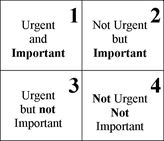
III. We Must Choose Between the Urgent and the Important.
Four Types of Tasks:

  • Those Tasks which are Urgent and Important
    • Do these First.
  • Those Tasks which are Not Urgent, but Important
    • Spend Your Time Here.
  • Those Tasks which are Urgent, but Not Important
    • Minimize These.
  • Those Tasks which are Not Urgent and Not Important.
    • Eliminate These.

Conclusion

  • What Should Go in Quadrant 2 (Not Urgent, but Important):
    • Your Relationship with God
    • Your Physical Health
    • Your Marriage / Family
    • Your Church Responsibilities
    • Your Work Responsibilities
    • Your Other Relationships
    • Your Dreams, Goals, Self-Improvement
  • Are You Doing Change God’s Way? (Acts 22:16; 1 John 1:9)

As we seek to make changes in our life – spiritual and physical, it is important to put “first things first!”  God demands we put him first in our allegiances, time, and goals. Further, we all understand that success in any endeavor requires we set priorities. Among other things, this means we must learn to choose between the urgent and important.


I’ve reproduced this chart from my message this coming Sunday. Our activities can be categorized in each of these four quadrants.
Q4 are things we need to minimize or eliminate.
Q3 are things which should be minimized.
Q1 are things we need to do first.
Q2 is where we need to spend most of our time.
Q2 includes things such as our

  • 1) relationship with God;
  • 2) physical health;
  • 3) marriage / family;
  • 4) church responsibilities;
  • 5) work responsibilities;
  • 6) other relationships;
  • 7) dreams, goals, self-improvement.

I’ll say more in the lesson.

I hope you will join us!  Joey

By | 2022-01-26T00:13:27-07:00 January 26th, 2022|Uncategorized|0 Comments

Doing Change God’s Way (Part 4)

Process Driven Change

Introduction

  • Resolutions Require Change, but it is Hard to Change
  • Doing Change God’s Way
  • Last week we discussed holistic change; today we will discuss process driven change.

I.  Goal Emphasis vs. System Emphasis (Process)

  • Coach: Goal=Championship; Process=Daily Practice.
  • Writer: Goal=Book; Process=Daily Writing Schedule.
  • Runner: Goal=Marathon; Process=Training Schedule.
  • Entrepreneur: Goal=Million Dollar Business; Process=Sales and Marketing Process

            Focus on the How, not the What.

II.  A Proven Formula for Success

III.  A Biblical Model

Conclusion

  • Six Reasons to Focus on Systems not Goals:
    • Goals Can Lead to Discouragement.
    • Goals Can Impede Long Term Progress.
    • Goals Imply there are Things we Can Control that we have No Control Over.
    • Systems are Working Plans for your Goals.
    • Systems, if Appropriately Designed, will Lead to Goal Achievement.
    • What you do Every Day (Your System/Process) Will Change Your Life.
  • Are You Doing Change God’s Way?

Since I’m originally from Alabama, it is probably no secret that I am a University of Alabama college football fan. I know there is a lot of hate for the program because of their unprecedented success over the last twelve years, but no one can argue with their success or the greatness of their coach. Nick Saban turned the program around, at least in part, due to what he has called “The Process.” He tells his players and assistant coaches, “Don’t think about winning the SEC Championship. Don’t think about the national championship. Think about what you needed to do in this drill, on this play, in this moment. That’s the process: Let’s think about what we can do today, the task at hand.”  This is also a biblical concept.

Our current lesson series, Doing Change God’s Way, is intended to help us make necessary changes in our lives. Change is difficult, but God has provided in his word a path to real change. Sunday, my lesson will discuss Process Driven Change.    I’ll say more on Sunday.

I hope you will join us!  Joey

By | 2022-01-22T13:01:18-07:00 January 22nd, 2022|Uncategorized|0 Comments